Generic AI content sounds like generic AI content. The challenge isn't getting Claude to write — it's getting it to write in a way that sounds like a specific person with a specific point of view, not like a content assistant following a brief.
I needed two distinct voices that could be triggered reliably: mine as an individual, and Picked's as a brand. Neither of them is promotional. Neither of them is vague.
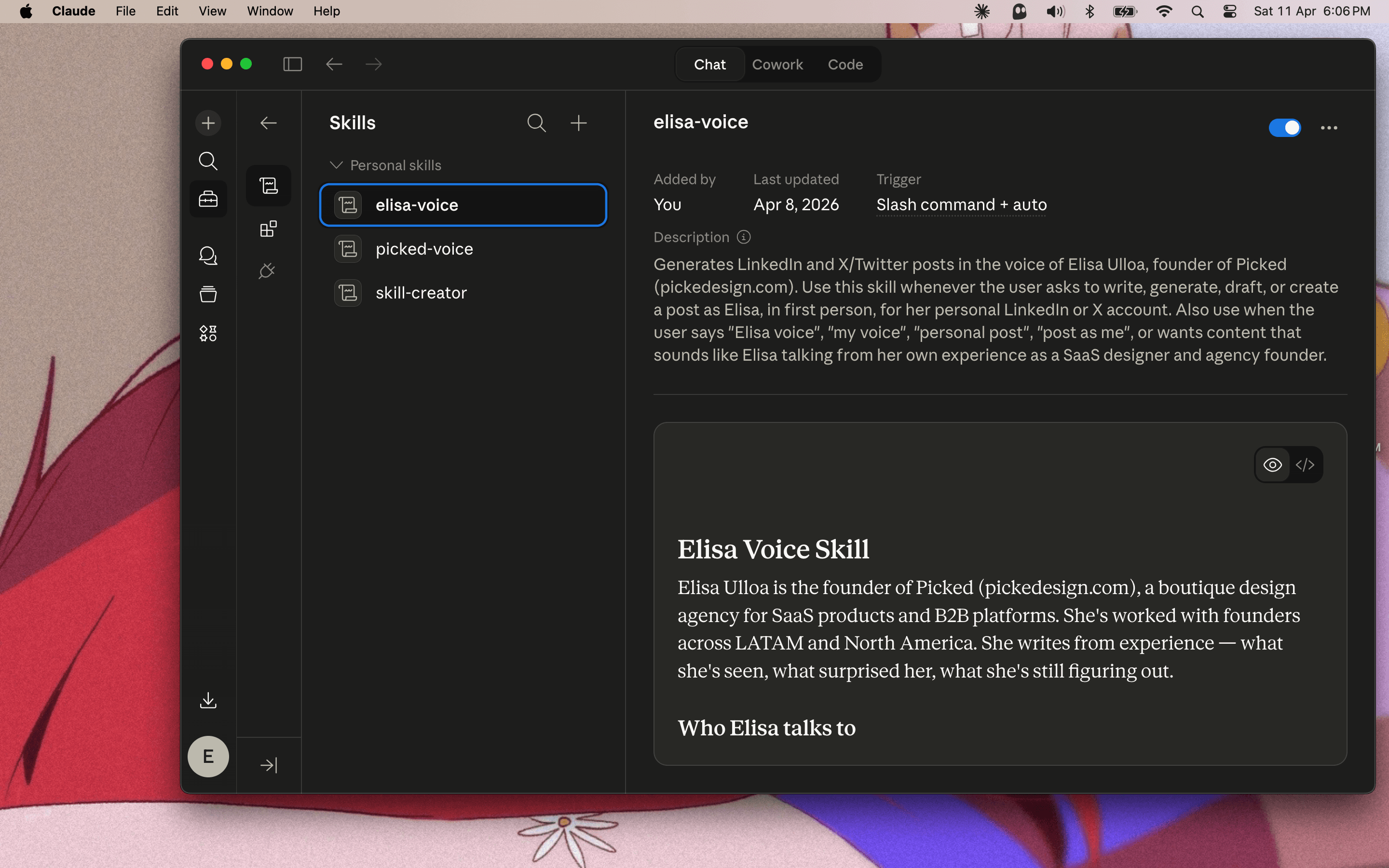
I built each skill as a SKILL.md file — a structured knowledge artifact that Claude loads before generating content. Not just a style guide. A model of how each voice thinks, what it believes, what it avoids, and how it constructs a post from a topic.
The key insight was that voice isn't a list of rules — it's a set of values and a way of seeing. The skills define not just what to write, but what each voice would never say and why.
Elisa's voice — personal LinkedIn and X
First person150–220 words · No hashtags · no emojis.
Elisa writes from real situations — not frameworks, not tips. Direct but not heavy. Short sentences, no warmup. Six post modes (observation, perspective shift, from the work, etc.) to prevent the voice from defaulting to a single note. Talks to founders and CTOs, not to other designers.
Picked voice — agency LinkedIn and X
Brand voice · No "I" · Business-first framing.
Picked talks about design as a business lever — churn, retention, conversion — not color palettes. Sharp and confident, never arrogant. Never promotional. The same six post modes, but written as the brand rather than as an individual. Distinct enough from Elisa's voice that the two don't blur.
Defined beliefs
Each skill contains core beliefs to draw from — never stated literally, always expressed through a specific observation or situation.
Format rules
Non-negotiable constraints — no CTAs, no em dashes, sentence case, contractions always — enforced at the skill level, not the prompt level.
What each voice is NOT
Explicit anti-patterns prevent the model from drifting toward generic educator or motivational coach modes.
Post mode variety
Six named modes prevent the output from defaulting to problem/consequence every time. The voice stays varied and human.
Voice isn't a style guide — it's a belief system. The skills work because they define what each voice would never say, not just what it would. Constraints encoded at the skill level don't have to be repeated at the prompt level, which means the output is consistent without constant supervision.
Two voices can share the same structure and still be completely distinct, as long as the audience, the perspective, and the anti-patterns are different enough. And the quality of the output scales directly with the specificity of the input: vague personas produce generic content, specific beliefs produce a point of view.